
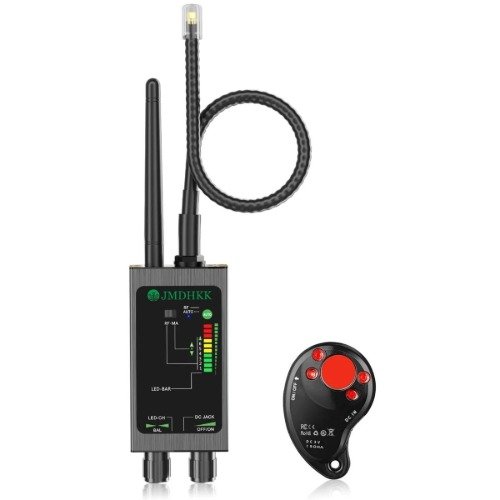
RF Bug Detector and Hidden Camera Anti-Spy Detector
Product Specifications
- Product type: RF bug detector and hidden camera detector
- Detection type: RF signal detection
- Application: Counter-surveillance and electronic privacy inspection
- Hidden camera detection: Supported as specified by the product
- Form factor: Handheld
- Brand: Not specified in the supplied product title
- Model: Not specified in the supplied product title
- RF frequency range: Confirm from the exact product model
- Detection range: Confirm from the exact product model
- Sensitivity: Confirm from the exact product model
- Power source: Confirm from the exact product model
- Battery capacity: Confirm from the exact product model
- Dimensions: Confirm from the exact product model
- Weight: Confirm from the exact product model
RF Bug Detector and Hidden Camera Anti-Spy Detector
The RF Bug Detector and Hidden Camera Detector is a handheld counter-surveillance device designed to help users identify radio-frequency signals and locate potential hidden electronic devices within its detection capability. It is intended for situations where users need to inspect rooms, offices, vehicles, accommodation spaces or other areas for possible RF-emitting devices. The exact detection range, frequency coverage, sensitivity and supported detection methods depend on the specific model supplied, so these specifications should be confirmed against the actual unit before purchase.
Product Features
RF Signal Detection
The detector is designed to identify radio-frequency (RF) signals within its supported frequency range. RF detection can help users identify the presence of transmitting electronic equipment operating within the detector’s coverage.
Hidden Device Inspection
The device can be used as part of a physical inspection for potential hidden electronic devices. An RF detector does not identify the purpose of every signal it detects, so unusual RF activity should be investigated rather than automatically treated as a hidden surveillance device.
Hidden Camera Detection
The product is marketed as a hidden camera detector, providing a tool for inspecting spaces where concealed cameras may be a concern. The effectiveness of camera detection depends on the detection technology incorporated into the specific model and the characteristics of the camera being inspected for.
Anti-Spy Inspection
An anti-spy detector can form part of a broader counter-surveillance inspection. It can be used alongside visual inspection and other appropriate security measures when checking a room, office, vehicle or other private area.
Portable Handheld Design
The handheld format allows the detector to be carried between different areas during an inspection. This is useful when checking multiple rooms or locations rather than relying on a permanently installed detection system.
Suitable for Different Inspection Environments
Depending on the specific model and its documented capabilities, an RF and hidden camera detector can be considered for inspections in:
- Offices
- Meeting rooms
- Hotel rooms
- Residential spaces
- Vehicles
- Private workspaces
- Other areas where electronic privacy is a concern
The suitability of the device depends on its actual detection specifications and the environment being inspected.
Product Specifications
- Product type: RF bug detector and hidden camera detector
- Detection type: RF signal detection
- Application: Counter-surveillance and electronic privacy inspection
- Hidden camera detection: Supported as specified by the product
- Form factor: Handheld
- Brand: Not specified in the supplied product title
- Model: Not specified in the supplied product title
- RF frequency range: Confirm from the exact product model
- Detection range: Confirm from the exact product model
- Sensitivity: Confirm from the exact product model
- Power source: Confirm from the exact product model
- Battery capacity: Confirm from the exact product model
- Dimensions: Confirm from the exact product model
- Weight: Confirm from the exact product model
How an RF Bug Detector Works
An RF bug detector detects radio-frequency energy within the frequency range supported by the device. Electronic equipment that transmits wirelessly may produce RF signals that can be detected by a suitable RF detector.
It is important to understand that detecting an RF signal does not automatically mean that a surveillance device is present. Wi-Fi routers, mobile phones, Bluetooth devices and other legitimate electronic equipment can also generate RF signals.
For that reason, an RF detector is best used as one part of a wider inspection rather than as conclusive proof that a particular device is a listening device or hidden camera.
Hidden Camera Detection
Hidden camera detection is a separate consideration from RF detection. Some concealed cameras may transmit wirelessly and therefore potentially produce detectable RF signals, while other cameras may store recordings locally or operate in ways that do not produce an RF signal detectable by a particular device.
For this reason, users should follow the detection methods and limitations documented for the specific detector they purchase.
Where to Use a Bug Detector
The product can be considered for privacy inspections in locations such as:
Offices and Meeting Rooms
Businesses can inspect sensitive meeting areas when there is a legitimate need to assess electronic privacy.
Hotel and Accommodation Spaces
Users may use a detector as part of a personal inspection of an accommodation space where privacy is a concern.
Vehicles
The device can also be used during an inspection of a vehicle for potential RF-emitting electronic equipment.
Private Spaces
Residential and private workspaces can also be inspected using appropriate counter-surveillance equipment.
Important Considerations When Buying an RF Detector
The product name alone does not provide enough information to compare RF detectors accurately. Before purchasing, check:
- RF frequency coverage
- Detection sensitivity
- Detection range
- Whether hidden-camera detection is optical, RF-based or both
- Alert method
- Power source and battery specifications
- Physical dimensions
- Weight
- Supported detection modes
- Manufacturer and model number
These specifications can vary significantly between different bug detector models.
Why Choose an RF Bug Detector from Zeneric Networks Limited?
At Zeneric Networks Limited, we focus on matching products to their documented capabilities rather than presenting every RF detector as capable of detecting every type of surveillance device.
If you are purchasing this type of equipment, we recommend confirming the exact model, RF frequency coverage, detection method and other specifications before placing an order.
Contact Zeneric Networks Limited in Nairobi for product specifications, current pricing and availability.
Be the first to review “RF Bug Detector and Hidden Camera Anti-Spy Detector”
Related products

Fire and CCTV equipment
Fire and CCTV equipment
Security Systems
Security Systems
EZVIZ C2C Indoor Wi-Fi Camera – Compact 1080p Security Camera

Fire and CCTV equipment
Reviews
There are no reviews yet.